
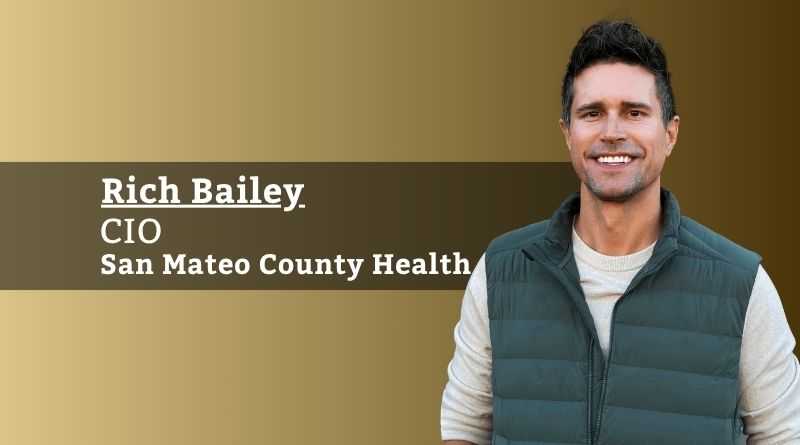
AI Is Icing, Not the Cake
By Rich Bailey, CIO, San Mateo County Health
Walk into our behavioral health division on any given day, and you may still see paper moving between people or Excel used for reporting. Not because anyone wants it that way, but because that division has not yet been integrated into our full Epic environment. Meanwhile, four floors away, a primary care team is managing the same patient’s chart digitally in real time, with full visibility into history, medications, and care plans. Same county, same patients and clients, two completely different realities. That gap is the true starting line for AI in behavioral health, and it’s one that most conversations about AI skip over.
I am the CIO for a county safety net health system, and we are expanding our Epic environment, which we call Mosaic, to four additional divisions, including Behavioral Health and Recovery Services, which is not a small technical lift. It is the difference between a fragmented county health system and one in which a patient’s care can be managed as a continuum across divisions by the people who serve them. Once we are interoperable with ourselves, we can extend that interoperability outward through frameworks such as TEFCA and California’s Data Exchange Framework (DxF), and connect with the broader care ecosystem that is American healthcare, which our patients are required to navigate.
I say all that because I think it matters how we talk about AI in this space. AI is not the floor we build on; it is something we add once the floor is solid in a foundation that rests on data literacy and digital enablement. At San Mateo County, in the heart of Silicon Valley, we are not chasing AI while the foundational technology we have already invested in, a single, integrated EMR, is still being implemented across our divisions. That is not caution for caution’s sake; it is sequencing. You do not add bells and whistles to a train without tracks.
AI is not the floor we build on; it is something we add once the floor is solid in a foundation that rests on data literacy and digital enablement.
This matters even more in behavioral health than in most other parts of the care continuum, because the stakes for trust, privacy, and human judgment are higher here, not lower. I have had many conversations lately with colleagues across the industry about the risks of AI and agents, specifically those given access to systems and allowed to act without a human reviewing their actions. The examples that come up are not hypothetical: agents sending money to the wrong party, agents sending patient communications without anyone checking the content first. These are not edge cases; they are what happens when you remove the human from the loop in a domain where the cost of being wrong is someone’s care, someone’s privacy, and someone’s trust in the system meant to help them.
Healthcare, or more specifically, the care of human beings, is not the ideal place to hand a workflow entirely to a machine from start to finish. AI can be enormously useful as a recommendation engine, surfacing options for a clinician or an administrator to review and approve. What it should not do is own that workflow end-to-end without built-in quality assurance or a proven record with your institution’s patient population. The technology can be a partner, but it should not be the last word this early in the AI healthcare wave.
So how do we decide when AI clears the bar? At San Mateo County, we run governance differently than most people expect. We do not bring a solution in search of a problem, nor do we show up to our governance group with “AI” as our pitch. We show up with a human-centered need, something rooted in actually serving our community. Nine times out of ten, our technology portfolio can address it without anyone needing to reach for the newest tool on the market, in this case, AI. Our process is built around keeping our patients and clients at the center of every decision, not the technology itself. That distinction sounds small, but it’s not. It is the difference between innovation that serves people and innovation that serves itself, and between adopting AI because it is available and adopting it because it is needed.
Here is where that bar gets tested in a real way. Imagine an AI agent handling a patient inquiry that touches on substance use treatment history, information protected under 42 CFR Part 2, among the most tightly regulated categories of health data. An agent acting without a human reviewing that exchange could disclose protected information that it was never authorized to share, with real consequences for the patient and the organization. That is exactly the kind of need our governance process is built to catch before it becomes a problem, not after.
And that is also where I land on the optimistic side of this conversation, not the cautious one. Innovation is genuinely my passion, and it is the part of this job I care about most. The goal is not to slow AI down for its own sake; it is to ensure that when a real need arises, one where AI is genuinely the right tool, we already have the governance, the integrated systems, and the human-centered process in place to deploy it well. Interoperability is not the opposite of intelligence. It is what makes intelligence trustworthy enough to use. AI is the icing, it’s not the cake.