
Canon Medical Systems USA: Made for Every Life: Canon Medical’s Humane, High-Impact Imaging
The healthcare industry is marked by persistent challenges—staffing shortages, workforce burnout, and the need to demonstrate ROI amid stringent financial constraints. These collective forces necessitate rethinking investment priorities, innovation pathways, and technological advancements that enhance clinical performance and patient outcomes. For over a century now, one notable entity, Canon, has been at the forefront of innovation. By expanding into the healthcare and medtech space, Canon Medical Systems USA offers a robust portfolio of medical imaging solutions including angiography, CT, MR, ultrasound, and X-ray, alongside comprehensive healthcare IT solutions designed to optimize clinical workflows and quality of care. With strategic integration of advanced imaging modalities and IT, Canon Medical Systems USA actively addresses operational, technical, and business realities.
Canon Medical Systems USA is supported by the extensive in‑house R&D initiatives of its parent company, enabling healthcare providers to access tools that help improve diagnostic precision and timely care interventions. This approach ensures state‑of‑the‑art technology alongside tailored financial options.
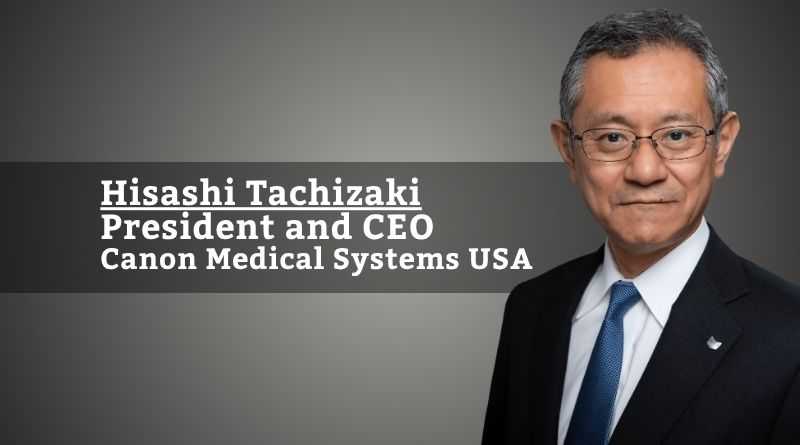
Appointed President and CEO of Canon Medical’s U.S. operations in 2023, Hisashi Tachizaki embodies the company’s commitment to the philosophy ‘Made for Every Life.’ Beginning his career as a mechanical engineer, his leadership perspective was shaped by the demands and trends of the healthcare industry. His formative years working in the United States gave him firsthand insight into the operational challenges and expectations of the market, and these experiences refined his focus on developing ideas and technologies that meaningfully improve patient care. They also taught him to view research and development through the lens of the entire CT system and the people who rely on it, rather than mechanical design alone.
Innovations That Start with Listening to People
Innovation doesn’t just begin in the lab alone. It starts with listening to the concerns that clinical and care providers face and the challenges patients face related to access and experiences. Canon Medical exemplifies this by prioritizing accessibility, supporting vendor-neutral interoperability, and enabling patient-centeredcare pathways.
In research-intensive healthcare and life sciences industries, unproven innovations carry real risks to patients’ lives and the community. Canon Medical’s deep collaboration with medical, academic, and research institutions co-creates, validates, and refines technologies that are built on trust, transparency, and shared purpose to deliver real economic value and support all stakeholders. In summary, healthcare breakthroughs must have an impact that goes beyond solving an engineering problem. This approach is reflected across the U.S. through Canon Medical’s research facilities in Boston, Chicago, and now in Cleveland with the Imaging Resource Center due to open in the next year. Together, these centers foster advancements in clinical and technology-based collaborations that will drive the next generation of innovation, while partnering with frontline leaders in healthcare delivery and research.
Canon Medical allows providers to consistently deliver flagship-level quality across their entire enterprise, from major hospitals to outpatient imaging centers, irrespective of site and budget complexity.
AI-powered, Automation-first, and Data-backed Imaging
Canon Medical’s AI strategy stands apart for its grounding in clinical relevance and proven capabilities. Rather than chasing trends with AI as a bolt-in capability, the company integrates AI across the care value chain, delivering automated workflows that build efficiency and productivity.
Canon Medical’s AI-powered, automation-first, and data-backed imaging solutions directly address these requirements by empowering organizations with streamlined workflow automation at scale to reduce burnout from staff shortages so that providers can focus on improving patient care. Through a harmonized product portfolio, Canon Medical allows providers to consistently deliver flagship-level quality across their entire enterprise, from major hospitals to outpatient imaging centers, irrespective of site and budget complexity. These advancements include AI-powered tools that help providers triage life‑threatening conditions such as stroke, pulmonary embolism, and aortic dissection, delivering fast, accurate clinical insights that enhance operational efficiency and support time‑critical decisions across emergency and stroke care teams.
The imaging operations are further enhanced by advanced data capabilities for protocol standardization across the CT and MR fleet, vendor-agnostic analytics and imaging, and automated tracking of radiation dose information across modalities to support effective, system-wide dose management.
Together, these capabilities translate to more than a tech stack: they serve as accelerators for team collaboration, care and performance consistency, and improved patient safety across systems and locations. For instance, Canon’s Remote Assist solution enables Steinberg Diagnostic Medical Imaging, which operates 12 locations and employs more than 50 MRI technologists, to leverage the guidance of its most experienced technologists for remote exam setup. This strengthens care for complex cases and helps maintain protocol consistency while eliminating the need for on-site experts.
4D CT Innovations Aligned to Clinical Trends and Health Needs
Canon Medical’s innovations are closely aligned with clinical trends like rising chronic diseases and obesity in the U.S. The company has engineered systems with large, open bores and patient-friendly designs to help elevate a broader range of patient needs with advanced AI-powered tools to elevate diagnostic confidence with clarity and accuracy across oncology and cardiology. Canon’s 4D CT technology, a hybrid CT and angiography system refined through years of collaborative advancements with leading physicians, addresses some of the most complex clinical cases.
The system marks a decade in advancing care across the U.S. and is recognized as a preferred solution for accessible and cost-effective Ambulatory Surgery Centers and Office-Based Labs amid the shift of procedures to outpatient settings. At the global level, 4D CT has transformed trauma care. Japan’s early adoption of this technology sparked a major shift in Emergency Department workflows, bringing whole-body CT and interventional treatment directly into the trauma bay.
A compelling case of 4D CT technology involves Canon’s partnership with CARTI (Central Arkansas Radiation Therapy Institute) which recently unveiled its one-stop cancer care and ambulatory surgical center on the West Little Rock campus. CARTI aimed to meet the needs of its patients by providing convenient access to interventional oncology and radiology services in local communities. The partnership addressed access, efficiency, and cost challenges in interventional oncology by implementing an integrated 4D CT suite in their new ambulatory surgery center. The solution combined CT and angiography in one room, eliminating patient transfers, shortening procedures, and enabling real‑time image‑guided interventions. In just one year, the 4D CT suite supported 1,781 additional procedures, significantly expanding access to timely care. It delivered strong quality outcomes, including a 3.3% 30‑day readmission rate, far below typical inpatient ranges. The center also realized a meaningful financial impact, generating up to $2.1 million in additional annual payments.
Similarly, at the Door County Medical Center (DCMC), a rural critical‑access hospital in Wisconsin, Canon’s AI-assisted CT system addressed severe CT technologist shortages, rising overtime, and workflow challenges caused by operating a 24/7 imaging service. The AI-enabled CT system introduced automated workflow tools that reduced scan complexity, cut workflow steps by 40%, and enabled cross‑training of staff from other modalities. These capabilities streamlined exam setup, improved scan consistency, and allowed technologists to work more efficiently and confidently.
Overtime call dropped by 41%, while technologist satisfaction and retention improved, and more staff requested CT cross‑training due to the system’s ease of use. At the same time, exams became faster and more comfortable for patients, and the medical center expanded outpatient services such as virtual colonoscopy and calcium scoring, which enhanced access and elevated the overall patient experience.
The View Ahead in 2026: A Commitment Towards a Humane Future
In 2026, Canon launched Phase VII of Canon’s Excellent Global Corporation Plan, with a strategic emphasis on productivity across development, manufacturing, sales, and human resources. By leveraging emerging technologies and their own productivity, the company plans to deliver products and solutions that enhance operational efficiency and human capital optimization. Additionally, the company is prioritizing its U.S. medical imaging business growth, supported by its commitment to establish Canon Healthcare USA in Ohio in 2022 with a $300 million investment and research partnership with The Cleveland Clinic. These initiatives position Canon Medical Group as a core pillar of the company’s long-term success, and a key contributor to meaningful healthcare outcomes in the U.S. and worldwide.
Note: The clinical results, performance and views described are the experience of the clinicians. Results may vary due to clinical setting, patient presentation and other factors. Many factors could cause the actual results and performance of Canon Medical’s products to be materially different from any of the aforementioned.