General Devices’ User Spotlight: Nassau, NY – Transforming Regional Emergency Communication Across 1,565 Users
Meet the Leaders Behind the Nassau Region’s Success
In Nassau County, NY, transforming emergency communication has been a true team effort. Many dedicated leaders, physicians, and EMS professionals have helped guide this regional project from its early development through its ongoing success including the long-time efforts of Dr. Josh and David Kugler, hospital partners, and regional EMS leadership.
Among those helping move the initiative forward are Dr. David Silver, Medical Director for multiple EMS agencies and Chair of the Nassau REMAC QA/QI Committee, and Don Hudson, EMS Academy Administrator and a REMSCO Council Member.
Dr. Silver, an emergency medicine physician with Northwell Health, began his career as a firefighter and EMT before returning to his EMS roots as a medical director and educator.
“I was a volunteer for seven or eight years, so I’ve been around for a while,” he shared. “I’m an emergency medicine physician by trade. I’ve been out of residency for 14 years, all here on Long Island with Northwell Health.”
Hudson’s path began at just 18 years old in his local volunteer fire department. “I started at 18, joined my local volunteer fire department… went to EMT school, then medic school, and was hired by the City of New York. I worked there for 19 years as an EMS paramedic, Instructor and then Paramedic Lieutenant”, he said. Now, as the Administrator of Nassau County’s EMS Academy, Hudson oversees education and training while helping coordinate region-wide communication initiatives.
Together with a network of regional collaborators, Dr. Silver and Hudson are helping drive a culture of innovation, communication, and teamwork that’s reshaping how Nassau connects care from the field to the hospital.
A Model for Regional Communication
Nassau’s success is more than the rollout of a new tool. It demonstrates what becomes possible when an entire region agrees that communication cannot break at jurisdictional lines. Emergency care is fast, complex, and rarely fits neatly within one organization’s boundaries. Patients move. Incident severity changes. Hospital availability fluctuates. When EMS and hospitals operate on separate protocols, platforms, or expectations, even a minute of delayed communication can set back patient care.
Regional standardization gives every provider, dispatcher, and clinician the same playbook. It means clinicians aren’t just hoping their message gets where it needs to go. They know it will.
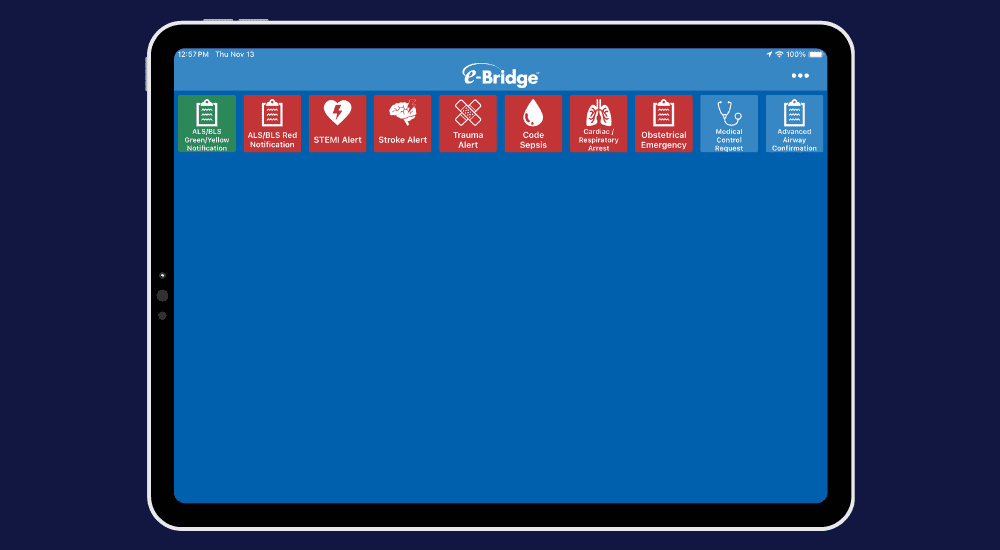
Nassau County embraced this belief early. Leaders recognized that if EMS teams could reliably share real-time data and visuals with hospitals before arrival, patient care could accelerate from the very first mile of transport. With e-Bridge, agencies no longer rely on descriptions traveling through layers of intermediaries. They deliver first-hand insight instantly.
As Hudson reflected:
“Since the seventies, we’ve been trying to train people to ‘paint the picture with your words. Well, if a picture’s worth a thousand words, what’s a video worth?”
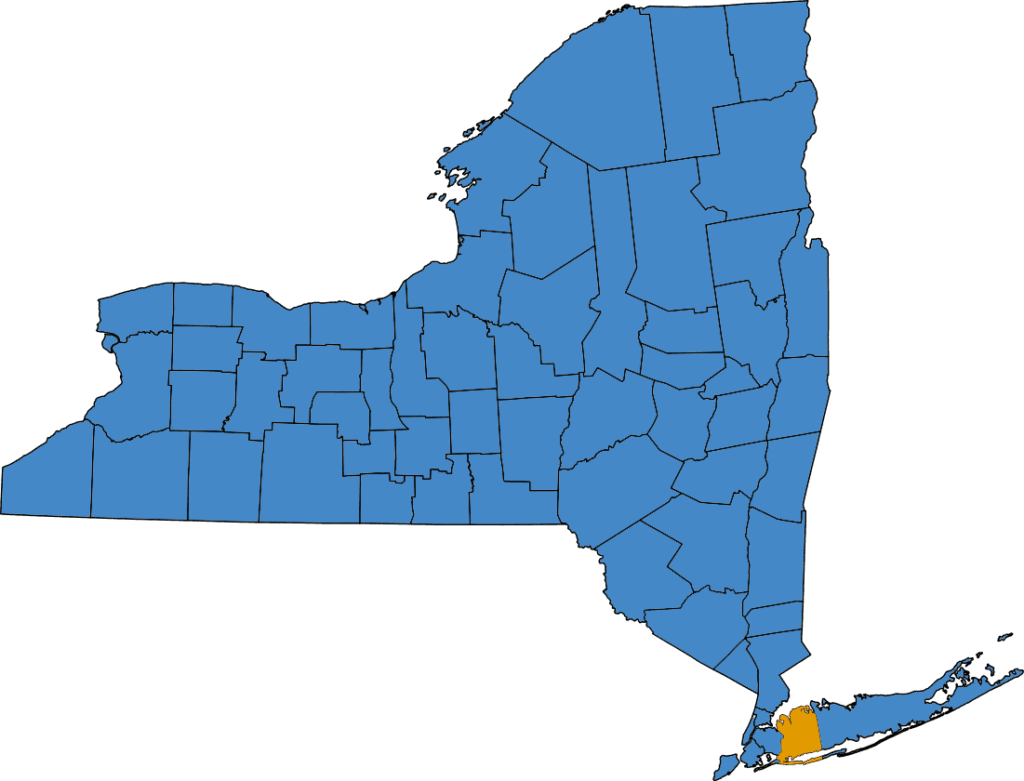
The region’s approach creates a unified ecosystem: one regional network, one communication standard, many hands working together. The result is one of the largest and most connected mobile telehealth deployments in New York State and a model for regions nationwide.
Fast Facts: Nassau County e-Bridge Program
The Need for e-Bridge Across the Region
Before e-Bridge, Nassau’s EMS-to-hospital communication relied heavily on radio transmission. It worked, but only to a point. Information often passed through multiple hands before reaching the emergency department, and by then, the finer details could be diluted, delayed, or lost entirely. As Hudson explained:
“Our radio-based medical control was not directly to the hospital. So, when Dr. Silver says we have played telephone, it was literally a second or third-hand information that the hospitals were getting.”
In an environment where minutes mean the difference between walking out of the hospital or a lifetime of impairment, uncertainty simply wasn’t acceptable. Critical data like suspected stroke symptoms, changes in vital signs, or evolving trauma concerns needed to travel faster.
Hospitals needed a clearer picture earlier. And EMS needed a way to communicate without juggling equipment or hoping someone on the other end caught every word.
Across local agencies, leaders saw similar frustrations:
- Communication delays when hospitals were busy or radio traffic was heavy
- Difficulty confirming that messages were heard and understood
- No ability to share images, video, or diagnostic insights
- Limited visibility into which patients were coming and when
The region was ready for a system that didn’t just notify hospitals but connected them in real time.
That desire for stronger, more unified collaboration brought together Nassau EMS Leadership (REMSCO/REMAC), and all the hospitals in the Region. Their shared mission: eliminate fragmentation and build a connected digital communication network that puts the patient at the center of every exchange.
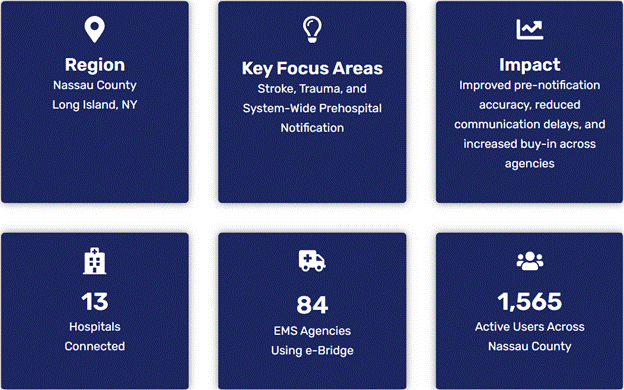
Through this coordinated effort, the region successfully linked all 84 EMS agencies and 13 hospitals through the e-Bridge platform, creating one of the most comprehensive regional deployments in the state. More than 700 providers across the region now use e-Bridge, along with Northwell EMS’s structure of 865 individual users, each equipped to communicate directly and consistently.
Hudson highlighted the transformation simply:
“Every hospital is using it, every EMS agency’s using it in one way, shape, and form.”
The telephone game is finally over. In its place: a real-time, visual, and collaborative connection that ensures every patient story arrives without interruption.