Driving Revenue Cycle Transformation Through Analytics, Automation, and AI
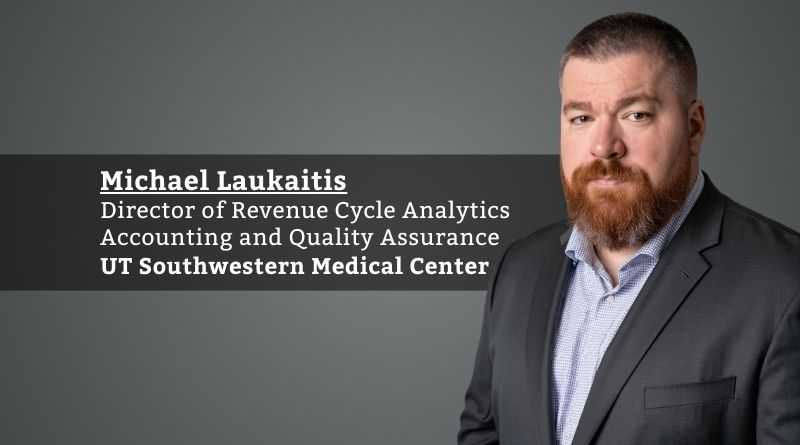
By Michael Laukaitis, Director of Revenue Cycle Analytics, Accounting and Quality Assurance, UT Southwestern Medical Center
The revenue cycle has never been a static function; however, in recent years, it has evolved faster than ever. At our organization, the revenue cycle analytics, RPA, and AI department operates outside the traditional IT shop, giving us both the agility and the accountability to move quickly. Our focus is simple: using data, automation, and intelligent technology to make processes faster, cleaner, and more effective, all while maintaining compliance and quality without losing sight on them.
Challenges We Face
Our challenges are the same ones keeping many revenue cycle leaders up at night. We work with an ever-changing payer landscape, where policy updates, regulatory requirements, and shifting reimbursement models can hit productivity and accuracy overnight. Manual processes remain in pockets of the revenue cycle, creating unnecessary touches that slow down payment timelines. Turning that information into actionable insight across multiple systems takes intentional investment in advanced analytics tools and skilled personnel.
Beyond the operational hurdles, there’s also a cultural one: building an analytics and automation program outside of IT means we need to constantly earn trust, demonstrate ROI, and prove that it’s a driver of real, measurable impact.
By keeping ownership in the revenue cycle department, we ensure automations and analytics tools are aligned with the day-to-day realities of our staff, not just the theoretical best practice.
Strategies We’ve Implemented
To tackle these challenges, we’ve built our team strategically. Partnering with an automation implementation firm has been a key decision. They’ve helped us accelerate our automation program while we’ve recruited and trained the right people in-house. This hybrid approach ensures we’re not just deploying tools but developing a sustainable automation culture.
We house our analytics team within our revenue cycle. That proximity enables us to quickly identify process inefficiencies, evaluate the automation potential, and prioritize solutions that directly affect cash flow and patient experience. We’ve also embraced agentic AI.
One example of agentic AI is our AI Payer Policy agent, which continuously scans payer websites for policy changes, downloads the relevant documentation, analyzes them, and produces an actionable summary of the changes. Not just faster, it’s more reliable than relying on email updates or word-of-mouth from payer reps.
Impact of New Technologies
Integrating new technology is never just about flipping a switch. With each new platform, we’ve been intentional about change management. We partner with operational leaders early, involve end users in testing, and use data to validate improvements before scaling.
When we implemented a solution from a leading automation provider, we focused on 10 targeted automations in the first year with processes we knew would have a clear, measurable impact on revenue cycle performance. That focus, combined with our implementation partner’s expertise, gave us credibility and momentum. By the end of the first year, those automations were delivering a robust ROI, and more importantly, they freed our team to work on higher-value tasks.
We also make sure technology isn’t seen as “something IT made us use.” By keeping ownership in the revenue cycle department, we ensure automations and analytics tools are aligned with the day-to-day realities of our staff, not just the theoretical best practice.
Prioritizing and Evaluating New Technologies
We don’t evaluate new technologies based on hype. Our approach is grounded in three key questions:
- Does this directly impact revenue cycle KPIs?
- Can it integrate with our existing systems without creating more manual work?
- Can we quickly measure and prove the ROI?
This framework keeps us from over-investing in solutions that are “nice to have” but don’t drive measurable value.
The partnership with our implementation partner is a prime example of this approach in action. They brought both the technical skills, and the implementation discipline we needed to go live with multiple high-value automations in under a year. Without that outside expertise, we would have taken longer to ramp up, which would have delayed our ROI and risked program fatigue.
Staying Compliant in a Changing Regulatory Environment
Revenue cycle compliance is a moving target. The challenge isn’t just knowing when regulations change, it’s understanding how those changes impact your workflows, documentation, and system configuration.
Our Agentic AI Payer Policy agent has been a game-changer here. Instead of relying on analysts to sift through lengthy policy updates, the AI identifies the changes, interprets them, and flags those that require action. That same agent could map those changes against our Epic workflows, highlighting where a process needs to be updated to remain compliant.
We’ve also developed an AI analysis tool that reviews how staff navigate Epic, identifies steps that add no value, and pinpoints those ripe for automation. This provides us with a double benefit: we stay compliant, and we continuously improve efficiency.
The Cultural Shift
Technology alone doesn’t create transformation; people do. One of our biggest successes has been building a culture where analytics and automation aren’t seen as “extra” work, but as part of the job. We’ve made it clear that our goal is not to replace staff but to remove the repetitive, error-prone tasks that prevent them from doing the work only humans can do, solving problems, supporting patients, and making judgment calls.
Looking Ahead
The next frontier for us is scaling agentic AI beyond isolated use cases, building systems that can proactively identify revenue risks and take corrective action before a denial ever happens.
In the end, the key to success remains the same as it was on day one: listen to the people doing the work, give them tools that make their jobs easier, and measure everything. If it moves the needle on revenue cycle performance and improves the staff and patient experience, it’s worth our time. If it doesn’t, it’s just noise.