Reimagining Revenue Cycle Operations in a Changing Healthcare Environment
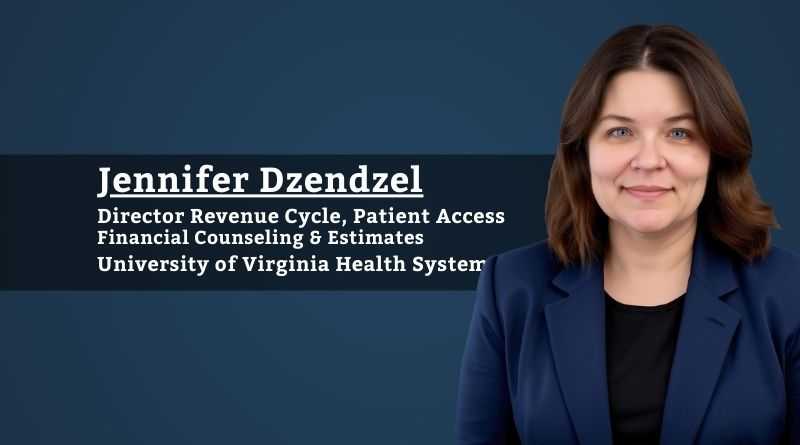
By Jennifer Dzendzel, Director, Revenue Cycle, Patient Access, Financial Counseling & Estimates, and Bret Stearns, Director, Revenue Cycle, Enterprise Facility Billing, University of Virginia Health System
At UVA Health, we take pride in our integrated revenue cycle, anchored by a world-class academic medical center and supported by a broad network of primary and specialty care clinics. Over the past three years, we have expanded our footprint by adding three community hospitals and a community medical group—introducing new dimensions and complexity to our revenue cycle operations. Today, our team comprises more than 800 skilled professionals who collectively generate over 1.5 million claims annually. In an environment defined by continuous change, we remain agile—constantly adapting and innovating to optimize reimbursement and support the financial health of our organization.
Agility and innovation drive our revenue cycle, ensuring patients receive care without financial barriers.
The Challenge of Modern Revenue Cycle Management (RCM)
Insurance verification and prior authorizations are critical to securing final payment. However, our team often finds itself chasing down verification details, which then delays the authorization process. This is especially challenging with Medicaid recipients, who can change payers every 30 days, and with payers offering multiple plans within the same geographic area—some of which are contracted with our entire health system, while others only serve a portion of our market.

To address these complexities, we rely on our internal IT team to embed messaging within the EHR and partner with select vendors to identify and address any missed verifications among our patient population. Compounding the issue, many payers now delegate authorization responsibilities to third-party administrators (TPAs), which has led to misinformation and confusion.
A significant challenge arises from the lack of communication between payers and their TPAs regarding who holds decision-making authority for authorizations. Jason Schenk, our pre-access unit director, explains that this forces our authorization specialists into the role of intermediary, causing delays in care delivery. In some cases, third parties send incorrect authorization data to payers, resulting in denials even when approvals have been secured.
Resolving these issues is difficult, as it requires coordinated efforts between our team, the TPA, and the payer. We mitigate the burden of acting as the “middle-person” by deepening our understanding of payer workflows, tracking recurring issues, and sharing insights with payer representatives. Still, the time spent navigating these inefficiencies reduces overall team productivity.
When discrepancies arise—such as a denial due to misalignment between payer and third-party records—we rely on documentation, including portal screenshots and electronic or mailed authorization letters, to validate that approval was obtained.
As payers continue to evolve their policies, we must remain quick-moving in our response. Nowhere is this more evident than in the increasing volume of denials and underpayments. We frequently contend with inpatient downgrades based on medical necessity and underpayments tied to level-of-care determinations. In many cases, payers retract previously approved claims following internal reviews—without ever requesting medical records. This forces us to proactively submit additional documentation to validate the level of care, particularly for outpatient services.
To address inpatient medical necessity denials, we’ve recently launched several key initiatives that were previously vendor-supported, including peer-to-peer reviews and internal appeals led by clinicians. We are also actively exploring AI-driven solutions to streamline and strengthen our approach to medical necessity denials.
An Integrated, Technology-Driven Approach
Patient financial clearance is a critical component of the overall patient experience. Our goal is to identify a funding source for every patient—whether through insurance coverage or financial assistance. For uninsured patients, our financial counselors, in partnership with a vendor, assist in completing Medicaid applications. If a patient is ineligible for Medicaid, we immediately screen for financial assistance. Our comprehensive financial assistance program includes 10 tiers and supports patients with household incomes up to 400% of the Federal poverty level (FPL).
Despite these efforts, there are instances where traditional funding avenues fall short. In such cases, our team provides patients with an out-of-pocket cost estimate and educates them on our zero-interest payment plan options—helping to prevent “sticker shock” and fostering a more positive billing experience. Agility and innovation drive our revenue cycle, ensuring patients receive care without financial barriers.
A Culture of Continuous Improvement
We also recognize that education and transparency are essential to building trust with our patients. That’s why we’ve invested in training our front-line staff to communicate clearly about coverage options, financial assistance, and billing expectations. Our team works diligently to ensure patients understand their benefits and responsibilities, thereby reducing confusion, and improving satisfaction. In addition, we’ve implemented automated alerts to flag potential coverage gaps and/or changes prior to procedures. These proactive measures not only improve the patient experience but also enhance claim accuracy and reduce denials. As we continue to grow and evolve, our commitment remains steadfast: to deliver compassionate, financially accessible care while maintaining operational excellence. By aligning technology, people, and process, UVA Health is redefining what it means to manage a revenue cycle in today’s complex healthcare landscape.